Hai mai giocato a Jenga?
Tutto inizia con una piccola oscillazione: un’operazione di backup che procede più lentamente del solito, un avviso di sicurezza ignorato, una casella di conformità lasciata deselezionata. Ogni cambiamento, apparentemente insignificante, sembra di poco conto preso singolarmente. Ma col passare del tempo, la struttura si indebolisce. Poi, con una mossa sbagliata, tutto crolla. Forse te ne accorgi in tempo. Forse no.
A volte, gestire l’infrastruttura IT può sembrare un po’ come giocare a Jenga. Sotto gli strati di complessità si formano piccole crepe, che spesso passano inosservate finché non si trasformano in guasti gravi. Ma se il vostro sistema fosse in grado di rilevare questi spostamenti prima che diventino un problema? E se, invece di affannarvi a riparare le crepe, il vostro sistema IT rimanesse stabile?
That’s precisely where Commvault’s Arlie comes in. Short for “Autonomous Resilience,” Arlie is designed to deliver actionable insights, helping you save time, resolve threats, and tackle complexities. With your 24/7 AI-powered assistant, you can keep everything stable, secure, and running smoothly before issues escalate.
Come Commvault utilizza l’intelligenza artificiale per migliorare l’esperienza utente
AI has promised to revolutionize IT: faster troubleshooting, smarter automation, stronger defenses. But in reality, AI solutions can often hallucinate, be difficult to scale, cause data security concerns, and fail to adapt. What IT teams need isn’t more AI; they need AI that fits their world – accurate, scalable, secure, and smart enough to evolve.
Arlie isn’t a mere bolt-on chatbot or a pilot tool. It is designed to think, adapt, and automate IT operations with enterprise-grade precision. Arlie is natively embedded in Commvault Cloud, secure by design, and available where teams already work – through the console, chatbot, or API workflows. It scales across cloud, on-prem, hybrid, and air-gapped environments without disrupting existing architecture. That means real-time insights, smarter workflows, and fewer errors.
Inoltre, grazie alla sua onnipresenza, Arlie offre una visibilità a livello di sistema, fornendo risposte alle domande più importanti. Ad esempio, può aiutare in attività quali la creazione di report e la fornitura di una sintesi giornaliera in tempo reale degli aspetti più rilevanti. Se si verificano problemi con le macchine virtuali critiche, Arlie è in grado di fornire report che mostrano i backup non riusciti su tali macchine virtuali, insieme alle cause specifiche, alle spiegazioni e alle possibili soluzioni.
Not only is Arlie your new favorite colleague, capable of executing tedious organizational tasks effortlessly, but it’s also simple to understand and easy to use. It’s readily available to Commvault Cloud software customers at theclick of a button.
Come ragiona Arlie: il cervello dietro l’assistente
Dietro ogni interazione fluida con Arlie si cela un’architettura progettata con cura, pensata per garantire precisione, sicurezza e affidabilità nel mondo dell’IT, dove la posta in gioco è alta.
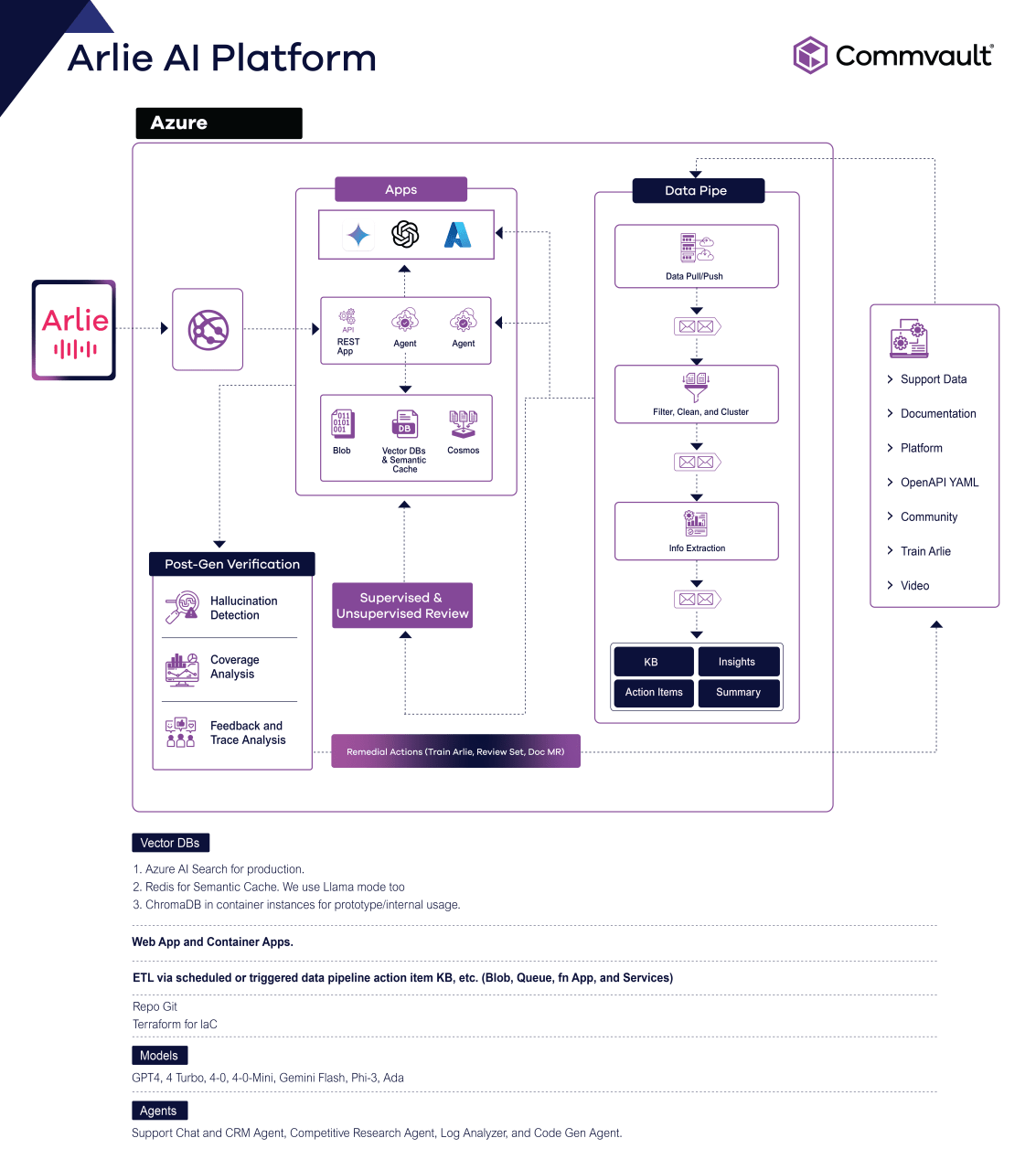
Diamo uno sguardo più da vicino a come Arlie affronta le sfide legate all’intelligenza artificiale che altri strumenti non riescono a superare.
Un’intelligenza artificiale che si adatta senza difficoltà alle esigenze aziendali
Le soluzioni di intelligenza artificiale promettono spesso efficienza, ma hanno difficoltà a gestire carichi di lavoro su scala aziendale. Ecco perché:
- Compute-heavy, slow, and costly. Many AI models require massive resources, making them impractical for large IT environments.
- Performance degrades under real-world loads. AI tools that work well in demos often fail when scaled across thousands of systems.
- Rigid architectures. AI solutions with fixed infrastructure can’t adapt to fluctuating IT demands, leading to bottlenecks.
Arlie è in grado di gestire in modo efficiente carichi di lavoro elevati senza compromettere le prestazioni né superare i budget. Offre:
- Lightweight AI processing . Arlie optimizes compute usage, running AI models efficiently without excessive power consumption.
- Adaptive workload balancing. AI dynamically scales up or down based on real-time demand, preventing slowdowns.
- Multi-environment deployment. Arlie runs in the cloud, on-prem, or in air-gapped environments, making it adaptable for any IT infrastructure.
- API-first integration. Seamlessly embeds into existing workflows, allowing enterprises to scale AI across thousands of systems without re-engineering.
- BYO language model and vector index. Whether you’re using OpenAI, Gemini, Llama, or bringing your own LLM and vector store, Arlie adapts. Bring your own vector DB (Qdrant, Azure AI Search, or Cosmos DB).
Un’intelligenza artificiale che riduce al minimo le allucinazioni
Uno dei principali ostacoli alla fiducia nell’IA è il fenomeno delle “allucinazioni”, ovvero quando i modelli generano con sicurezza risposte inesatte o fuorvianti. Tra i problemi figurano:
- Chatbots guess instead of knowing. Without verified context, AI tools often “fill in the blanks,” creating risk instead of clarity.
- Static LLM outputs lack accountability. There’s no built-in way to cross-check if an answer is right.
- Misinformation slows down IT teams. Instead of solving problems, teams waste time validating AI output.
Arlie is built on a retrieval-augmented generation framework – meaning it retrieves answers from trusted, enterprise-verified sources before responding. The benefits of this approach include:
- Contextual retrieval over generation. Arlie pulls from known documentation, logs, and past incident records – not just an LLM’s language prediction.
- Semantic vector search. It understands user intent and maps it to relevant data – not just keywords.
- Real-time hallucination tracking. If confidence is low or coverage gaps are found, the response is flagged, re-evaluated, or withheld.
- Continuous validation. Engineers review flagged responses, feeding structured feedback back into the model for ongoing refinement.
Un’intelligenza artificiale che riduce al minimo i rischi legati ai dati fin dalla progettazione
I modelli di intelligenza artificiale non vengono sempre sviluppati tenendo conto della sicurezza. Anzi, possono addirittura trattare i dati aziendali come se fossero dati di test, prestando scarsa attenzione alla conformità, all’isolamento o ai controlli di accesso. Tra i problemi riscontrati figurano:
- LLMs trained on sensitive data. Some AI tools inadvertently retain or reuse customer inputs, creating massive security liabilities.
- Opaque data flows. Enterprises can’t always tell where their data is going or how it’s being processed.
- Poor fit for regulated industries. Most AI assistants aren’t equipped for air-gapped environments, compliance audits, or strict data governance.
Arlie è progettato per garantire la sicurezza, con controlli che soddisfano le esigenze dei settori più regolamentati – dalla finanza alla pubblica amministrazione. Arlie offre:
- Customer data safeguarded. Customer data is never used to train AI models. Only metadata and structured query logs are analyzed – never content.
- Sandboxed AI environments. Arlie runs in an isolated, secure framework that helps reduce data spillage across tenants.
- Multi-environment deployment. Supports cloud, on-prem, and air-gapped installations, so that AI capabilities don’t compromise control.
- Policy-aligned automation. Arlie, detects unauthorized access patterns, and helps enforce security and compliance policies automatically.
Un’intelligenza artificiale che apprende e si evolve
L’IA non è statica. I vostri sistemi si evolvono, le minacce cambiano, i flussi di lavoro si trasformano. Ma la maggior parte degli strumenti di IA non lo fa. Una volta implementati, raggiungono un plateau. Questo approccio presenta alcuni svantaggi, tra cui:
- No learning from real-world use. Many assistants don’t refine outputs over time, repeating the same inaccuracies.
- Blind to feedback. If a user flags an error, it doesn’t necessarily feed back into the system for improvement.
- Can’t adjust to changing infrastructure. AI that isn’t tuned continuously becomes outdated fast – especially in dynamic enterprise environments.
Arlie è progettato con cicli di apprendimento continui, che gli consentono di migliorare ad ogni interazione. I vantaggi di questo approccio sono:
- Supervised and unsupervised learning. Flagged responses are manually reviewed by engineers while anomaly detection models track low-confidence outputs.
- Adaptive tuning. Arlie adjusts semantic search weightings, threshold scores, and ranking algorithms based on what works in the field.
- Refinement through usage. Every log it analyzes and every workflow it supports helps make future outputs smarter and faster.
- Prevents repeat failures. Arlie identifies recurring error patterns and tunes its recommendations to resolve them earlier next time.
Non solo IA. IA che funziona.
AI in IT can’t afford to be experimental. It needs to be scalable, secure, accurate, and adaptive – ready to perform under pressure and evolve with complexity. That’s exactly what Arlie delivers.
Instead of guessing, it verifies. Instead of overloading systems, it optimizes them. Instead of creating noise, it cuts through it. Deeply embedded across your IT environment – from workloads to workflows – Arlie is more than an assistant. It’s part of your infrastructure.