Protección continua de datos
La protección continua de datos (CDP) permite a las grandes empresas de hoy en día tener la seguridad de que sus datos se pueden recuperar tras ciberataques, cortes de suministro, desastres naturales u otros fallos.
What is CDP?
Making the Case for Continuous Data Protection
La protección continua de datos permite documentar todos los cambios y minimiza la pérdida de datos tras ciberataques, interrupciones del servicio o fallos.
Data is perhaps the most valuable resource for businesses in the digital age.
Continuous data protection (CDP) empowers enterprise businesses today to have the confidence that their data can be recovered in the wake of cyberattacks, outages, natural disasters, or other failures. CDP is a real-time data backup strategy that saves and documents a copy of changes made to data, which enables files to be restored from different points in time.
This is important because it can helpminimize data loss and protect against threatssuch as malware, ransomware, and accidental deletion. This level of real-time backup is paramount when considering the ever-evolving threat landscape and persistent malicious attacks from bad actors.
“IT leaders know that no amount of preparation is guaranteed to keep attackers out. Therefore, having absolute certainty of data survival and recovery in the face of any attack type is a requirement for any organization,” according toIDC’s Improving Data Resilience with a Cloud-First Approach report.
CDP creates a snapshot of data modifications and transaction that occurs in an enterprise, which then enables rapid recovery of data in the event it is lost, corrupted, or modified. This solves the problem of the backup window in which enterprise organizations are at risk of losing data created or modified between two scheduled backups.
Without CDP, if new data is created – and then lost or corrupted between scheduled backup windows – it might be unrecoverable. CDP lets enterprises capture an up-to-date copy of their information and allows data to be restored from different points in time.
Beneficios
Benefits of Continuous Data Protection
Data protection has always been top of mind for organizations, but today’s businesses have amassed volumes of data that is at risk from growing threats. This requires an evolved approach to enable organizations with distributed data storage to have the same level of protection regardless of the system on which it resides.
And while it is impossible to prevent all attacks, it is critical organizations are able to remediate and recover from an attack or data breach. CDP takes up a critical role in this effort to enable a business to continue to operate by evaluating and testing clean points, standing up safe environments,recovering backed up data sets, and continually protecting and testing data in air-gapped instances. An important aspect of CDP is to leverage data awareness to proactively alert IT teams when threats arise.
With CDP in place, enterprises can achieve many benefits.
Reduced risk of data loss: Because CDP constantly collects updates, changes, or modifications as well as tracks new data, it is less likely that data will be lost during an event. The capture of transaction and associated date keeps a near-real-time record of data and reduces the risk of data loss.
Low recovery point objective:RPO is the maximum amount of data loss that can be tolerated after an unplanned incident, usually represented as a timeframe. Because CDP maintains an up-to-date copy of data, it is able to recover data rapidly in the event it is lost or corrupted.
Better data availability: With CDP, data is more easily accessible to those with the rights to use it. Critical systems and applications will be able to continue accessing data.
Faster recovery following attack: CDP can speed recovery times for a business that has suffered an attack. The up-to-date record of data will more quickly get systems and applications back to running smoothly.
Constant data syncing: Because CDP collects changes related to data, the data will be accurate when a system crashes and it needs to be recovered.
Version control: The capability makes it possible to save multiple versions of data and minimize any damage or deletion of data in the instance that another user is accessing the data.
Rollback options: Because CDP keeps data current, organizations can roll back to the desired version of data if there is an attack or other event.
CDP represents few downsides for enterprise organizations, but it can become a single point of failure, require an investment in physical disk storage, and increase load on data resources – unless businesses choose to invest in a cloud-based CDP offering.
Características
Protección continua de datos basada en la nube
La CDP permite una recuperación rápida y completa de los datos y, cuando se ofrece a través de un servicio basado en la nube, también permite a las empresas proteger sus datos, anticiparse a los riesgos, minimizar la pérdida de datos y recuperarse rápidamente ante cualquier amenaza.
Los servicios de protección de datos basados en la nube mitigan los costes y el riesgo de un único punto de fallo, al tiempo que proporcionan a las grandes empresas una mayor resiliencia de los datos que puede acelerar la Recovery ante ataques de ransomware, malware u otros ataques maliciosos. Los proveedores de CDP basados en la nube pueden dedicar especialistas en seguridad a proteger los datos y la infraestructura, además de alojar los datos en una ubicación externa, lo que los protege mejor frente a filtraciones y ataques.
La CDP prestada a través de un servicio en la nube también puede ofrecer seguridad centralizada y eficiencia en los costes. Por ejemplo, la CDP tradicional podría requerir grandes equipos físicos que el equipo de TI debe instalar, mantener y actualizar. Con un proveedor en la nube, las copias de seguridad de los datos pueden automatizarse y el cifrado en la nube puede mantener los datos en un estado de solo lectura que solo los usuarios autorizados pueden descifrar, lo que protegerá los datos si el sistema se ve comprometido.
Las ofertas en la nube también pueden suponer un menor coste inicial a la hora de invertir en CDP y unos gastos operativos y de mantenimiento continuos más bajos. Con la promesa de una mayor fiabilidad y disponibilidad, el CDP basado en la nube puede escalar más fácilmente y proporcionar a las empresas una gran flexibilidad.
«Con estos recursos en la nube y soluciones de software avanzadas, las organizaciones pueden implementar estrategias de protección por capas que les brinden la mejor oportunidad para una Recovery rápida y precisa tras un ciberataque», afirma IDC en su informe. «Las soluciones “como servicio”, ya sean de copia de seguridad, recuperación ante desastres o ciberrecuperación, simplifican esas operaciones y dejan tiempo al equipo de TI para dedicarse a proyectos de mayor valor. Al combinar software y operaciones avanzadas de ciberresiliencia con recursos en la nube para el almacenamiento y la inmutabilidad, los equipos de TI pueden adoptar medidas proactivas para minimizar las posibilidades de sufrir un incidente de ransomware devastador».
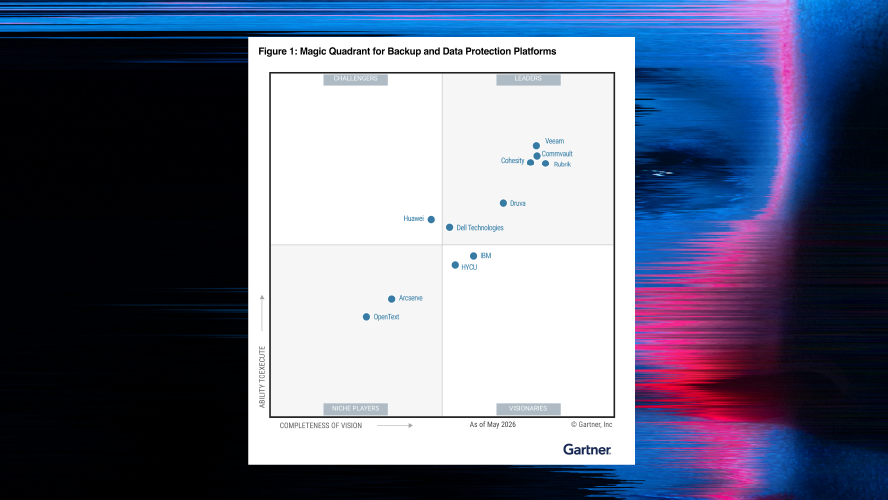
Cuadrante Mágico™ de Gartner®

Protección de datos en puntos finales: Lista de comprobación para el comprador